The Spirit of Sports at RC
Who can forget the first time they picked up a tennis racket or bounced on the trampoline at RC? Ran around the Plateau or tried their hand at archery? Being introduced to such a wide array of sports on a campus that makes this diversity possible is truly one of the many privileges of an RC education. More important — and even more lasting — is the spirit of fair competition, discipline, and sportsmanship instilled in RC students through this wonderful medium. In this issue, RCQ explores sports at RC — past, present, and future.
A sound mind in a sound body: One of the most beloved principles of Atatürk has also served as a guiding light to RC right from the start. RC co-founder Cyrus Hamlin staunchly believed that physical education needed to be an integral part of student training. As a result, a robust physical education program was already in place as early as 1863. As Dağhan Irmak states in his article “At the Heart of Sports: Robert College” in the book The Anatomy of a Tradition: 150 years of Robert College, physical education in the Ottoman Empire at the time was mostly synonymous with military training, even as a sports renaissance was gaining momentum in the West. Against this backdrop, RC stood out as a true pioneer.
In 1896, the same year as the first modern Olympics, the RC Sports Club was founded — among the very first sports clubs in the Ottoman Empire. The Olympic movement’s ideals inspired RC’s own tradition of athletics and gave rise to the beloved Field Day. The first Field Day took place in 1897, and in the years that followed, the range of events grew so broad that RC likely hosted the most comprehensive athletic competitions in the Empire at the time.
In late 19th century, soccer was taking Europe by storm, and Foreign Ministery employee and RC teacher Reşat Danyal wanted to experience this sport. He helped establish a Turkish soccer team called “Black Stockings” in 1899, and according to some sources the first meeting to create the team took place on RC campus. Though the team was discontinued due to political reasons, the soccer fire was lit at RC and burned on through the years.
Another milestone was the opening of the Dodge Gymnasium in 1904. Named after donor William Dodge, it was the first school gymnasium in Europe, and it was there, in 1908, that the first basketball game in Turkey was played.
To the Olympics and Beyond
In the meantime, the Ottoman Empire warmed to the idea of sports. RC students attended the 1905 Intercalated Games (Summer Olympics in 1906). Michael Doricaz RC 07 won a bronze medal in shot put, broke the world record in javelin throwing the next year and won a silver medal in javelin in the 1908 Olympics. He also attended the 1912 Olympics along with two other RC athletes: Vahram Papazyan RC 13 and Mıgırdiç Mıgıryan.
Indeed RC boasts many Olympians among its ranks. For example, Apostolos Nikalaidis RC 16 is a prominent RC athlete from that time. He participated in soccer, basketball, athletics, and volleyball at RC and was also a Fenerbahçe player. He was discovered by a Panathinaikos coach who was visiting RC and went on to become a sports legend in Greece. He represented Greece in the 1920 Olympics both in soccer and decathlon.
Şekip Engineri RC 23 competed in the 100-meter race in the 1924 Olympics and broke Turkey’s first 110 meter hurdles record in 1928. In 1936, Turkish national basketball team had three RC students, and it was this team that went to the 1936 Olympics in Berlin. Sadri Usuoğlu RC 30 and Kamil Ocak RC 35 played against Egpyt and Chile.
The first female Olympian from Turkey is also an RC alumnus: Halet Çamlıbel ACG 35. Çamlıbel was one of the two female athletes who represented Turkey at the 1936 Berlin Olympics. Her branch was fencing, and her attendance was personally requested by Mustafa Kemal Atatürk.
Starting in 1920, RC joined the Istanbul Basketball League, completing several undefeated seasons and winning multiple Istanbul championships. The 1930s were a particularly strong era for RC basketball, with many students playing for Galatasaray and Fenerbahçe, and with Rupen Semerciyan RC 26 and Naili Moran RC 32 going on to become national players.
Over the following decades, RC continued to expand the range of sports it offered — from badminton, boxing, and fencing to gymnastics, judo, horseback riding, skiing, and weightlifting. Table tennis was introduced to Turkey through RC, and the country’s first athletic championship was also held at the school.
The national players that emerged from RC in these decades reflect the expanding range: Emin Doybak RC 55 (Track, 1952 Olympics), Samim Uygun RC 61 (football), Reşat Kayalı RC 66 (Track), Fatih Tar RC 71 (Decathlon), Ahmet Kayalı RC 72 (Triple Jump)
Teachers, Coaches, Mentors: Lifelong Impact of Sports Educators
Teachers were pivotal in enabling students to experience the wide array of sports at RC and build lifelong skills and values.
One such teacher was Alexander Nadolsky who joined RC at 1925. A former Russian officer and fencing expert, Nadolsky was a complete athlete. He even introduced swimming to the activities offered at school and swam with students on the Bosphorus. RC history teacher Önder Kaya writes about this extraordinary life journey in a separate article.
Another versatile and strong athlete among RC teachers’ ranks was Abbas Sakarya. He was a wrestler for Beşiktaş and was the first Turkish wrestler to have won a medal in an international championship. Sakarya taught at RC between 1959 and 1977 and was also the co-founder of Istanbul Yüzme İhtisas Kulübü.
“Forsgrenisms”: Running With Robert Forsgren
A PE teacher whose influence spanned far and wide is Robert Forsgren. Ali Mirza Önder RC 89 reminisces about how he instilled a lifelong passion for running in so many students:
“In Orta when we thought of sports, only ball games came to mind. We couldn’t understand why anyone would run without a ball in front of them. More importantly, we didn’t enjoy running. The idea that there were people who ran simply for the sake of running — and actually enjoyed it — was completely foreign to us.
Enter Mr. Forsgren. Over the next four years, he turned a group of students — those who didn’t have the talent for football or basketball, and who hadn’t made those teams — into real athletes. Some of us became outstanding in shot put and discus, others in high jump and long-distance running.
Mr. Forsgren taught us to enjoy what you do, regardless of the outcome.
When your goal shifts from “winning” to “enjoying,” and when the only condition for that enjoyment is “doing your very best,” then no matter the result — you’ve already won.
That was the greatest lesson Mr. Forsgren taught us, and we have carried that philosophy into the rest of our lives.
We all knew the “Forsgrenisms” by heart:
- Shared miles feel shorter. He taught us how fun running together could be.
- Champions don’t come from empty, lonely tracks. He often reminded us how friendly competition quietly pushes everyone to be better.
- What we do in the past doesn’t define what we can do in the future. As long as we can dream and work toward that dream, we are all capable of far more than we think.
- Everyone (lucky enough) has two legs. He would remind us never to put others on a pedestal — in running or in life — because of our own prejudices.
In short, Mr. Forsgren was such a great athlete that, despite our youth, none of us could push ourselves to our limits the way he could.He was such a great coach that even a child like me, with zero athletic background, became an “OK” runner under his guidance. He was such a great teacher — he guided and inspired us, yet always stayed quietly on the sidelines, letting us feel that our accomplishments were truly our own.”
Honoring a Legacy: The Story Behind the Dave Phillips Field
Yet another legendary physical education teacher was Dave Phillips, who was also RC’s basketball coach. A leader in the civil rights movement in the States, Phillips joined RC in 1979 and also professionally played basketball in Beşiktaş. By the time he retired in 2012, he had touched upon many students’s lives in unforgettable ways during a remarkable 33 years at RC. His influence was so strong that when he retired after three decades, students galvanized to honor his legacy. Mehveş Dramur RC 96 recalls this extraordinary show of devotion.
“It all began when one day, Mehmet Pekarun RC 87 visited the Advancement Office with a heartfelt idea. He wished to find a meaningful way to honor our beloved basketball coach and PE teacher, Dave Phillips, who was preparing to retire after a long and impactful career at Robert College.
What started as a simple conversation quickly evolved into an inspiring initiative. After compiling a list of all former basketball players spanning more than three decades, an action committee was formed to bring the idea to life.
At the time, what is now known as the Dave Phillips Field was a dry, uneven patch of land. Over the years, staff and students had expressed the wish to transform the area into a more functional and sustainable space. Various proposals had been discussed, but all required significant financial resources. Given the school’s other priorities and limited budget, the field had remained a dream deferred—until then.
The committee ultimately decided to convert the unused land into a modern soccer field with sustainable artificial grass, ensuring long-term usability and low maintenance. The estimated cost of the project was comparable to that of an endowed scholarship, and when the Board of Trustees approved the plan, the action team eagerly began reaching out to former teammates and alumni.
What followed was a remarkable display of RC spirit and community solidarity. Contributions flowed in quickly, and the greatest challenge turned out not to be fundraising—but keeping the project a secret from Dave Phillips himself.
That mission, too, was accomplished. On May 19, during the school’s annual celebrations, the team revealed the project and presented it as a surprise gift to Coach Phillips, who was deeply moved.
The celebrations continued with a lively farewell party at the Forum, where former students, athletes, and colleagues gathered to honor Coach Phillips’s legacy. It was a night filled with memories, laughter, and heartfelt tributes—an unforgettable send-off for a teacher and coach who had inspired generations both on and off the court.”
RC Alumni Accomplished Many Firsts in Sports
With so many good mentors among the teachers, a lot of RC alumni who were involved with sports at school went on to play critical roles in the Turkish and international sports worlds.
Indeed presidents and founders of sports clubs are galore among RC alumni:
Bedii Yazıcı RC 37 was one of the top basketball players at RC, as well as a soccer player for Fenerbahçe; he later served as the president of the Fenerbahçe Club in 1953-1954.Tuna Baltacıoğlu RC 44 founded Altınyurt Sports Club, with Memet Fuat Bengü RC 44 as a coach by his side. Şenes Erzik RA 61, the first elected president of the Turkish Football Federation, who later served senior positions at FIFA and UEFA, is also an RC alumnus. Alp Yalman RC 59 who served as the president of Galatasaray Sports Club between 1990-1996, transferred German coach Jupp Derwall, thus contributing sginificantly to the modernization of Turkish soccer. Ahmet Güvener RC 72 held important positions in the Turkish Football Federation and became the president of the Central Referee Committee and the Director of Football Development, as well as acting as an advisor to UEFA and FIFA. More recently, Serdar Bilgili RC 81served as the president of the Beşiktaş Sports Club in 2000-2004.
More than a century later, sports continue to be an integral part of the RC education, and more RC alumni will surely join the ranks of those before them who have carried the learnings of RC to the sports arena and beyond.
Sports at RC Today
Taught by a team of seven in English as part of the bilingual curriculum, physical education is still a core academic subject today. The facilities available are as impressive as ever: Transverse and a self-belay climbing wall, MPR, gymnasium, Dave Phillips Field, Grass plateau and tartan track, Faralyalı Trail, Outdoor Education – low and high elements, Bingham Courts and four Bingham tennis courts. The fitness, cardio and yoga rooms are relatively recent additions, and they are popular spaces used throughout the academic day, after school and at the weekend both by students and faculty.
Physical Education Department Head Elizabeth Molton underlines that there are four key tenets to the PE curriculum:
- Physical Literacy: This tenet helps develop confidence and competence across a diverse range of physical activities. Emphasis is on skill development, fitness routines, and exposure to individual, self-paced activities and team games. Through physical literacy, students gain lifelong, sustainable health and fitness habits.
- Social-Emotional Health: This tenet directly addresses students’ stress reduction, emotional balance and anxiety management through movement-based and well-being practices.
- Inclusive Physical Education: Through the inclusivity lens, RC physical education approach ensures participation is safe, supportive, and accessible for all students. Activities are modified to meet diverse abilities and skill levels.
- Technology Integration: Utilization of fitness apps and data insights for personalized feedback are now a natuarl extension of physical fitness. Technology integration helps motivate students through visualization of improvement and achievement.
RC takes an interdisciplinary approach to learning, and physical education is often integrated to lessons in LP English as well as to Community Involvement Projects. A fine example is how the reading of the book Lord of the Flies was paired with outdoor activities.
Dean of Student Activitie George Scorgie explains that there are numerous extracurricular activities related to sports:
“Out of 149 CTIs (Clubs, Teams and Initiatives), there are 28 sports related CTIs across social and competitive sports.
The program is quite comprehensive; if a student has a particular interest we can usually find a place to accommodate them: RC has junior and senior competitive teams in many of the MEB team sports; health and fitness clubs for weights and cardio style activities, runners that include coaching and running in events such as half marathons, multiple martial arts, adventure sports and semi competitive sports in sailing and rowing. There are over 200 students training each week, participating and competing, and there is sport generally everyday of the CTI week.
Many of the students sports clubs – outside of the competitive teams – are student suggested, so we are always evolving the program to match student needs and interests. A classic example of this is pickleball, a sport becoming increasingly popular globally that started as an initiative last year before becoming a full weekly club this year.
Something we are also continuing to develop this year is grassroots sport opportunities that support students developing into competitive players. We have started tennis clinic, table tennis club and added more focused exercise-related CTIs to support students’ physical and skill development with the goals of broadening the pathways for players to learn, grow and compete in future years.”
Athletic Director Mauricio Araya Gonçalves divulges RC’s coaching philosophy:
“At Robert College, we aim to foster a positive and supportive environment where our student-athletes are encouraged to reach their full potential—both as individuals and as members of a team. Our coaches strive to instill the values of responsibility, self-respect, respect for others, sportsmanship, commitment, dedication, and teamwork. Robert College student-athletes are guided to always give their best effort, to win with humility and pride, and to accept defeat with dignity and grace.”
Currently the teams that compete in the MEB tournaments are boy’s/girl’s badminton, basketball, football, swimming, table tennis, tennis, volleyball. Gonçalves also co-founded a league called TISL (Turkey International Schools League), and RC teams have friendly matches and host and travel to tournaments in Istanbul, Ankara, İzmir, and Northern Cyprus in this league as well.”
It is no wonder that with such an integrative approach RC continues to support national athletes. RC’s recent and current national athletes are İpar Kurt RC 23 (Volleyball), Azra Betül Kılaç RC 27 (Ice Hockey), Yiğit Ege Güven RC 26 (Sailing), Taylan Özgür Ercan RC 21 (Swimming), Zehra Nehir Cihan (Fencing).
Gonçalves himself believes in inspiring students to see themselves as worthy individuals of a healthy lifestyle: “Inspiration means more than just teaching the rules of a game or the calories one should consume. Inspiration involves the act of creating a desire in students to have healthy habits from the table to the classroom. By understanding the needs and gifts of individuals, we can create learning experiences that are relevant to each child. ”
Basketball and Tennis CTIs Coach Davor Rimac states that RC students level of engagement and sense of responsibility as team members are strong: “My philosophy is to maximize student engagement and help them reach their highest possible performance. For instance, I usually select more than the required 10–12 players for basketball, but it always works out well. Different players substitute during games, and there is a strong sense of camaraderie and encouragement among everyone each time we play in a tournament. The ultimate goal is, of course, to have fun; however, after putting in hours of training, we also hope that students will recognize how they can make themselves and their teammates better players—and better individuals.”
Two Beloved Traditions: Field Day and RC Olympics
RC sports life has two important highlights during the year: Field Day and the RC Olympics.
As all RC students know and alumni fondly remember,Field Day is a day for students alone, marked with sports competitions, picnics, and in some years even the election of a King and Queen.
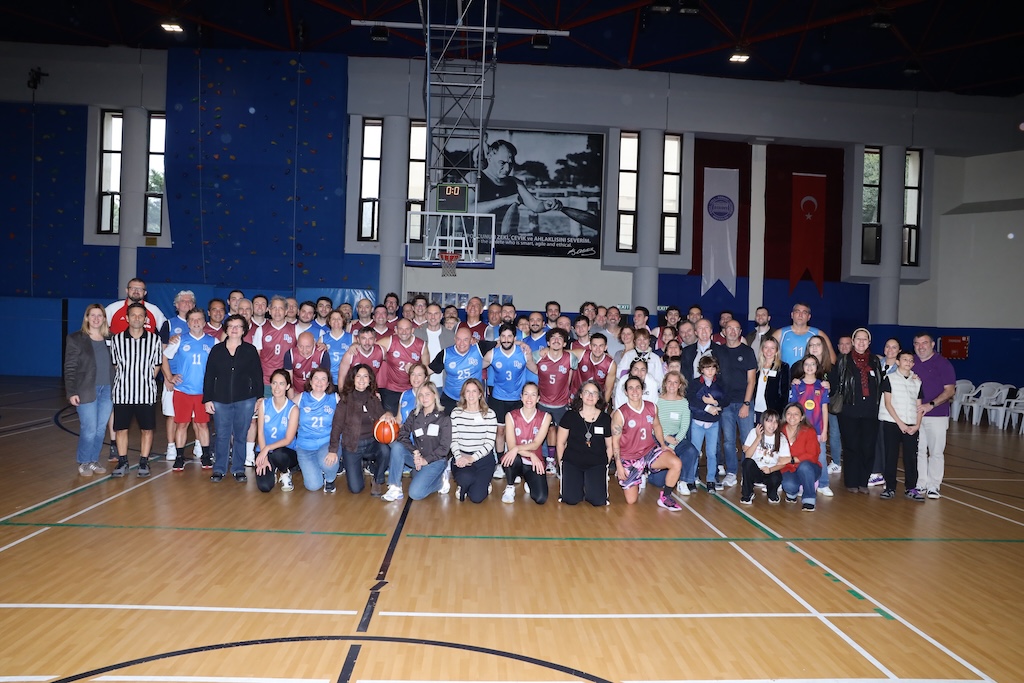
The RC Olympics, a tradition that started in 1897, was revived in 2025. The day brought together alumni, students, faculty, and friends for spirited team tournaments, individual competitions, and two signature highlights—the iconic Everesting Challenge, a special event led by Ahmet H. Uysal RC 90 and the Mount Ararat Challenge.
Participants of all ages tested their endurance, from completing 100 ascents between the Arnavutköy Gate and the Bridge to competing in table tennis, basketball, volleyball, and soccer. Beyond the thrill of competition, the event became a meaningful show of support for the RC Scholarship Fund, raising $30,000, evolving the tradition of sportsmanship and camaraderie into one with purpose.
RC takes its strong historical heritage in sports further and further every year with inspiring teachers and coaches, a holistic teaching philosophy that integrates technology, ever-expanding facilities and clubs, and, most importantly a spirit of sportsmanship, camaraderie and respect. RC students continue to demonstrate the principle that sound minds belong to sound bodies!