Fırat İşbecer RC 98 on Why Entrepreneurs Must Outgrow Their Companies

“I learned by making a lot of mistakes.”

Fırat İşbecer is the CEO of Commencis, a technology firm driving AI-powered digital transformation for large enterprises. One of Türkiye’s most active angel investors, he also serves on the board of Endeavor Türkiye, which supports founders building high-impact global companies.

How did you decide to become an entrepreneur?

Out of frustration! After completing my master’s degree at Sorbonne University, I joined a research institute in Paris. The work was repetitive, slow, and I felt underutilized. So I moved back to Türkiye and joined my brother as a co-founder at Pozitron. Eight years later, we sold the company, creating one of the largest software startup exits in Türkiye.

What were the biggest challenges along the way?

I started young, and many large enterprise clients didn’t take me seriously. But my biggest challenge was internal: I had to grow faster than the company. Every year the job changed, and I had to reinvent myself. I learned by making a lot of mistakes. Finance, leadership, and scaling teams did not come naturally.

Do you support or invest in other entrepreneurs?

Very actively. I’ve invested in nearly 70 startups and worked with more than 100 Turkish founders around the world. I care deeply about the entrepreneurial ecosystem.

If you were starting today, where would you focus?

Robotics, without a doubt, and health tech. Extending healthy human life is one of the most important and exciting challenges we can solve.

How do you reflect on your RC experience?

RC taught me to think globally. It surrounded me with smart, ambitious people and gave me a network of friends that continues to shape my life today.

Ergün Kırlıkovalı RA 70 Reflects on Discovery and Risk

“I felt so happy and light-headed when I made my discovery.”

Ergün Kırlıkovalı is a polymer scientist, inventor, and entrepreneur specializing in advanced polymer materials and aerospace technologies. He is widely recognized for his contributions to radar-absorbing materials.

How did you decide to become an entrepreneur?

I have always been involved in entrepreneurial endeavors to earn pocket money, like most kids in my neighborhood. Later, the RC culture of exploration, coupled with the adrenaline of competing to be the best you can be, was instrumental in shaping me. If there is any success, I owe it to my high-achieving RC teachers and schoolmates. The breaking point came in 1985 in the US, when my boss asked me which airplane jet he should buy. I quit my job, called my wife Juliana to tell her to sell our house, and follow me. Within 3 days, our new company was up and running.

What did it feel like when you made your discovery in radar-absorbing materials?

I felt so happy and lightheaded. I remember showing Juliana the 5 formulations on page 79 of my lab book and saying, “I can guarantee one of them will hit the bull’s-eye.” And sure enough, 79-4 did!

What are your recommendations to future entrepreneurs?

You need the right idea, appropriate education, reasonable experience, and at least modest resources. We sold our home and invested every penny in our business. If it failed, we would have to start over from scratch. Are you prepared to endure blows like that? If so, go ahead!

What was it like to visit the campus last November?

I tried hard to hide the tears in my eyes The memories of 60 years ago suddenly came back and crushed me under their weight.

Hüseyin Tığlı RA 71 Transformed From an Accidental Entrepreneur to an Intentional One

“If I could re-do my career, I would jump into the entrepreneurial world a lot sooner.”

Hüseyin Tığlı spearheaded the formation of the RC Community Entrepreneurs Bond (RCCEB) and here reflects on his own entrepreneurial journey.

Did you always want to be an entrepreneur?

While at RA, then at the engineering school at Columbia, then at Harvard Business School, I was really a “conventional thinker” —mostly focusing on routine academic success, though cherishing creativity and innovation.

In my early career as an engineer, I found myself in environments that welcomed creativity. For example, I loved applying Monte Carlo simulation to a critical technical design, linear programming to a thorny capacity planning problem. Later on in higher leadership positions, I loved trying unconventional management practices —one such example was allowing two pregnant, then young parents, to “share” the job of VP Manufacturing.

After a long corporate career, I accidentally came across a start-up opportunity. I’ve been an “intentional entrepreneur” ever since. If I could redo my career, I would jump into the entrepreneurial world a lot sooner.

How about successes and failures along the way?

In the last 20 plus years, I’ve founded and/or ran five start-ups, at times more than one at a time. I’ve had three exits and one complete failure. The fifth one created what I hope will turn out to be valuable IP. I’m currently incubating the sixth.

My failure perhaps offers the best pieces of advice to founders. Even a product offering that is both much higher in performance and lower cost than the competition does not ensure success. We had created biosensors on nano-porous silicon, read by sophisticated photonics. However, we misjudged the length of the sales cycle and therefore our go-to-market strategy and the financing strategy were not aligned with the real market dynamics. My personal mistake was falling in love with the technology and attempting to enter a market in which I had no experience. And not recruiting deeply critical or highly helpful Board members.

Two tidbits on success (other than routine advice such as “hire the best people,” etc.): 1) Allow “crazy ideas” to be tested —they could produce fantastic breakthroughs. In one of my photonic switch ventures, my team was stuck with a high cost/low performance design. They rejected a novel idea by a junior engineer and justified their opposition in numerous ways. I let the junior engineer try it —and this allowance turned out to be the most significant innovation in the entire industry. 2) Do not rely on the opinions of “experts.” On another occasion in another venture, another junior engineer wanted to try a different silicon etching method. Her boss, who had done her PhD on this topic, took out papers out of her desk and said: “Here, read these and understand why your idea won’t work!” It worked like a charm and was the idea that allowed us to make the product.

ReConnecting Our Community, Strengthening Our Future

This year at Robert College was defined by a powerful and meaningful theme: ReConnecting. In a world that continues to grow more complex, fast-paced, and challenging, the importance of community and meaningful relationships has never been greater. Throughout the year, students, faculty, alumni, parents, and friends of the College came together to celebrate the bonds that unite us and to reaffirm the enduring spirit of the RC community.

One of the most inspiring aspects of this year was the opportunity to engage with alumni across the globe. From gatherings in San Francisco, San Diego, Boston, New York, and London to events here in İstanbul, alumni reconnected not only with one another but also with the institution that helped shape their lives. These encounters demonstrated that while our graduates may be dispersed across continents and professions, they remain connected by a shared experience and a common commitment to Robert College.

The year was also marked by special moments that brought our community together and created lasting memories. Homecoming once again served as a joyful celebration of RC traditions and friendships spanning generations. The RC Olympics showcased school spirit, teamwork, and healthy competition, while numerous other events throughout the year strengthened ties among students, alumni, faculty, and families. These occasions reminded us that the true strength of Robert College lies not only in its academic excellence but also in the relationships that endure long after graduation. The resilience of the RC community was evident throughout the year. Challenges, whether local or global, have tested institutions and individuals alike. Yet time and again, our community demonstrated its ability to adapt, support one another, and emerge stronger. This resilience is one of Robert College’s defining characteristics and continues to serve as a source of inspiration for future generations.

That spirit of commitment and generosity was reflected in a remarkable milestone for the Scholarship Fund. Thanks to the extraordinary support of alumni, parents, and friends, this became a record-breaking year of giving. Their generosity ensures that talented students from diverse backgrounds will continue to have access to the transformative educational opportunities that define Robert College. Such support is a powerful expression of faith in the institution’s mission and in the potential of future generations.

The year also brought many achievements worth celebrating. Robert College successfully completed the NYSAIS accreditation process, reaffirming its commitment to excellence and continuous improvement. Students achieved outstanding university admissions results, earning places at some of the world’s most respected institutions. Academic accomplishments included notable successes in TÜBİTAK competitions and the Balkan Mathematical Olympiad, reflecting the intellectual curiosity and dedication of our students.

Beyond the classroom, RC students excelled in athletics and the arts. Teams and individuals achieved impressive results in Girls Flag Football, Basketball, and Chess, demonstrating discipline, teamwork, and perseverance. In the arts, students continued to inspire audiences through their creativity and talent. The Orchestra delivered memorable performances, while the RC Singers achieved international recognition by bringing home a Gold Medal, a fitting testament to the excellence and passion that characterize the performing arts at Robert College.

Underlying all these accomplishments is an important idea: stewardship. Each generation of Robert College students, faculty, alumni, and supporters inherits something valuable from those who came before. Our responsibility is not merely to preserve that legacy but to strengthen it, enrich it, and pass it on to those who follow. This commitment to stewardship ensures that Robert College remains a vibrant and dynamic institution while staying true to its enduring values.

As we look ahead, we do so with confidence and optimism. The future will undoubtedly bring new opportunities and challenges, but Robert College is well prepared to meet them. Grounded in its values, strengthened by its traditions, and sustained by the relationships that connect generations of students and alumni, the school continues to move forward with purpose. The spirit of ReConnecting has reminded us that our greatest strength lies in one another—and that together, we will continue to build a future worthy of the remarkable legacy we share.

RC 86: Forty Together

It had been a long wait, but RC ’86 finally came together to celebrate 40 years since graduation. Normally, we used to meet every five or ten years, but our planned 30th reunion in 2016 had to be cancelled following the events of July 15. Then came Covid, which kept us apart for even longer. So, when we finally met again in July 2026, it was not simply another reunion. It was our first big gathering in 15 years, making it especially meaningful, emotional — and, of course, very overdue!

We decided not to limit our 40th anniversary to one evening. Instead, throughout the year we created opportunities to meet, reconnect and enjoy being RC ’86 together. A dedicated committee of our classmates worked wholeheartedly throughout the year to bring these occasions to life. Earlier in the year, two of our classmates, both professional tour guides, took us on a fascinating historical tour of Istanbul, exploring some of the city’s remarkable treasures in the old town. We also gathered for a modern dance studio session hosted by one of our friends, enjoyed an evening of whisky tasting and even had a Sirtaki workshop before our reunion dinner. Apparently, 40 years later, we were still willing to learn new moves!

The reunion weekend itself began on July 16 with a boat trip along the Bosphorus, with families also joining us. It was a wonderful way to start the celebrations, with great food and beautiful views. For many of our friends who had travelled from the US and Europe, it was also a chance to rediscover the Bosphorus, which they had missed so much.

On July 18, 81 classmates gathered for our main reunion evening. We met in front of Gould Hall, walked together through our beautiful campus to the Deanery and enjoyed a cocktail hosted by Principal Whitman Shephard and his wife, Bengü. Seeing Mr. Shepard again was particularly special as he was our mathematics teacher in high school, making the evening feel like a wonderful reunion in more ways than one.

We returned to Gould Hall for our class photograph — in exactly the same spot where our graduation photograph had been taken 40 years earlier. Standing there together again was both joyful and nostalgic.

The dinner was held at Bizim Tepe, where our friend İbrahim Sözen talked about reflections on how Robert College shaped who we are, the enduring bonds we share and our common desire, since graduation, to contribute to society. One of the most emotional moments of the night was watching the video of our 1986 graduation ceremony, followed by a collage of photographs tracing our journey from Prep class through high school and then through the many gatherings that followed graduation. Live music by Sude Zeyrek RC 2020 followed, and at the end of her performance, our friends joined Sude on vocals and guitar, turning the evening into a joyful sing-along as we raised our voices together to some of RC ’86’s beloved songs, including “Together We Are Strong” and “Eski Dostlar.”

One more surprise followed. Those who had taken part in the Sirtaki workshop earlier on campus came onto the floor to show off what they had just learned. They performed a Sirtaki routine, proving that 40 years after graduation, we could still learn new steps — and perform them for our friends with great enthusiasm!

We then tested whether 40 years had improved or damaged our memories with a “Memory Trivia” covering our school years between 1979-1986. Our very own Nedim Saban moderated the trivia where there was plenty of laughter — and some highly questionable answers!

The evening continued on the dance floor until 2 a.m., with DJ Burak Süsoy RC 90 keeping us moving. Those who stayed overnight in the dormitories had the additional pleasure of returning, if only for one night, to a place that held so many memories of our younger years.

The following morning, families joined us again for brunch at Bizim Tepe before we finally said our goodbyes. We left with new memories, plenty of laughter and an even stronger appreciation of the friendships that have lasted all these years. We also carried home our special 40th-anniversary t-shirts and sweatshirts, featuring our “Forty Together” made from the names of all our classmates.

We had waited a long time for this reunion and it was definitely worth the wait. After 15 years apart, one thing was clear: we hope the next reunion comes much sooner!

Contributed by Gamze Ahıshalı Şulen RC 86

An Evening of Connection: RC Alumni Gather in Atlanta

On April 11, Robert College alumni in Atlanta came together for an evening at Truva in Virginia Highland, marking the first gathering of its kind in the city. With graduates ranging from RC 82 to RC 25, the event brought together multiple generations—an easy, natural reflection of the continuity that defines the RC community.

What began online quickly found its rhythm in person. Conversations moved with ease, connections deepened, and familiar threads—shared experiences, memories, and perspectives—surfaced across decades. For current students and recent graduates building their lives in the United States, the evening carried particular meaning. Encounters with more experienced alumni offered not only insight, but also a sense of orientation—a reminder that others have navigated similar paths.

The gathering itself grew organically. Initial connections formed through LinkedIn, supported by the Robert College Alumni Office, soon evolved into an active WhatsApp group. From there, the transition to an in-person meeting felt almost inevitable—an example of how the RC network continues to take shape in new environments.

There was, throughout the evening, a quiet sense of familiarity—of something shared, immediately understood. It is this quality that allows the Robert College community to re-form, wherever its members may be.

With plans to meet regularly, the Atlanta group has already established a presence of its own. This first gathering did not simply bring people together; it set something in motion.

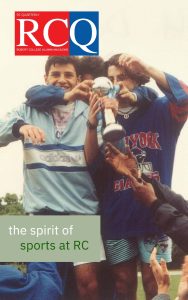
The Sports Issue

The Spirit of Sports at RC

Who can forget the first time they picked up a tennis racket or bounced on the trampoline at RC? Ran around the Plateau or tried their hand at archery? Being introduced to such a wide array of sports on a campus that makes this diversity possible is truly one of the many privileges of an RC education. More important — and even more lasting — is the spirit of fair competition, discipline, and sportsmanship instilled in RC students through this wonderful medium. In this issue, RCQ explores sports at RC — past, present, and future.

A sound mind in a sound body: One of the most beloved principles of Atatürk has also served as a guiding light to RC right from the start. RC co-founder Cyrus Hamlin staunchly believed that physical education needed to be an integral part of student training. As a result, a robust physical education program was already in place as early as 1863. As Dağhan Irmak states in his article “At the Heart of Sports: Robert College” in the book The Anatomy of a Tradition: 150 years of Robert College, physical education in the Ottoman Empire at the time was mostly synonymous with military training, even as a sports renaissance was gaining momentum in the West. Against this backdrop, RC stood out as a true pioneer.

In 1896, the same year as the first modern Olympics, the RC Sports Club was founded — among the very first sports clubs in the Ottoman Empire. The Olympic movement’s ideals inspired RC’s own tradition of athletics and gave rise to the beloved Field Day. The first Field Day took place in 1897, and in the years that followed, the range of events grew so broad that RC likely hosted the most comprehensive athletic competitions in the Empire at the time.

In late 19th century, soccer was taking Europe by storm, and Foreign Ministery employee and RC teacher Reşat Danyal wanted to experience this sport. He helped establish a Turkish soccer team called “Black Stockings” in 1899, and according to some sources the first meeting to create the team took place on RC campus. Though the team was discontinued due to political reasons, the soccer fire was lit at RC and burned on through the years.

Another milestone was the opening of the Dodge Gymnasium in 1904. Named after donor William Dodge, it was the first school gymnasium in Europe, and it was there, in 1908, that the first basketball game in Turkey was played.

To the Olympics and Beyond

In the meantime, the Ottoman Empire warmed to the idea of sports. RC students attended the 1905 Intercalated Games (Summer Olympics in 1906). Michael Doricaz RC 07 won a bronze medal in shot put, broke the world record in javelin throwing the next year and won a silver medal in javelin in the 1908 Olympics. He also attended the 1912 Olympics along with two other RC athletes: Vahram Papazyan RC 13 and Mıgırdiç Mıgıryan.

Indeed RC boasts many Olympians among its ranks. For example, Apostolos Nikalaidis RC 16 is a prominent RC athlete from that time. He participated in soccer, basketball, athletics, and volleyball at RC and was also a Fenerbahçe player. He was discovered by a Panathinaikos coach who was visiting RC and went on to become a sports legend in Greece. He represented Greece in the 1920 Olympics both in soccer and decathlon.

Şekip Engineri RC 23 competed in the 100-meter race in the 1924 Olympics and broke Turkey’s first 110 meter hurdles record in 1928. In 1936, Turkish national basketball team had three RC students, and it was this team that went to the 1936 Olympics in Berlin. Sadri Usuoğlu RC 30 and Kamil Ocak RC 35 played against Egpyt and Chile.

The first female Olympian from Turkey is also an RC alumnus: Halet Çamlıbel ACG 35. Çamlıbel was one of the two female athletes who represented Turkey at the 1936 Berlin Olympics. Her branch was fencing, and her attendance was personally requested by Mustafa Kemal Atatürk.

Starting in 1920, RC joined the Istanbul Basketball League, completing several undefeated seasons and winning multiple Istanbul championships. The 1930s were a particularly strong era for RC basketball, with many students playing for Galatasaray and Fenerbahçe, and with Rupen Semerciyan RC 26 and Naili Moran RC 32 going on to become national players.

Over the following decades, RC continued to expand the range of sports it offered — from badminton, boxing, and fencing to gymnastics, judo, horseback riding, skiing, and weightlifting. Table tennis was introduced to Turkey through RC, and the country’s first athletic championship was also held at the school.

The national players that emerged from RC in these decades reflect the expanding range: Emin Doybak RC 55 (Track, 1952 Olympics), Samim Uygun RC 61 (football), Reşat Kayalı RC 66 (Track), Fatih Tar RC 71 (Decathlon), Ahmet Kayalı RC 72 (Triple Jump)

Teachers, Coaches, Mentors: Lifelong Impact of Sports Educators

Teachers were pivotal in enabling students to experience the wide array of sports at RC and build lifelong skills and values.

One such teacher was Alexander Nadolsky who joined RC at 1925. A former Russian officer and fencing expert, Nadolsky was a complete athlete. He even introduced swimming to the activities offered at school and swam with students on the Bosphorus. RC history teacher Önder Kaya writes about this extraordinary life journey in a separate article.

Another versatile and strong athlete among RC teachers’ ranks was Abbas Sakarya. He was a wrestler for Beşiktaş and was the first Turkish wrestler to have won a medal in an international championship. Sakarya taught at RC between 1959 and 1977 and was also the co-founder of Istanbul Yüzme İhtisas Kulübü.

“Forsgrenisms”: Running With Robert Forsgren

A PE teacher whose influence spanned far and wide is Robert Forsgren. Ali Mirza Önder RC 89 reminisces about how he instilled a lifelong passion for running in so many students:

“In Orta when we thought of sports, only ball games came to mind. We couldn’t understand why anyone would run without a ball in front of them. More importantly, we didn’t enjoy running. The idea that there were people who ran simply for the sake of running — and actually enjoyed it — was completely foreign to us.

Enter Mr. Forsgren. Over the next four years, he turned a group of students — those who didn’t have the talent for football or basketball, and who hadn’t made those teams — into real athletes. Some of us became outstanding in shot put and discus, others in high jump and long-distance running.

Mr. Forsgren taught us to enjoy what you do, regardless of the outcome.

When your goal shifts from “winning” to “enjoying,” and when the only condition for that enjoyment is “doing your very best,” then no matter the result — you’ve already won.

That was the greatest lesson Mr. Forsgren taught us,  and we have carried that philosophy into the rest of our lives.

We all knew the “Forsgrenisms” by heart:

  • Shared miles feel shorter. He taught us how fun running together could be.
  • Champions don’t come from empty, lonely tracks. He often reminded us how friendly competition quietly pushes everyone to be better.
  • What we do in the past doesn’t define what we can do in the future. As long as we can dream and work toward that dream, we are all capable of far more than we think.
  • Everyone (lucky enough) has two legs. He would remind us never to put others on a pedestal — in running or in life — because of our own prejudices.

In short, Mr. Forsgren was such a great athlete that, despite our youth, none of us could push ourselves to our limits the way he could.He was such a great coach that even a child like me, with zero athletic background, became an “OK” runner under his guidance. He was such a great teacher — he guided and inspired us, yet always stayed quietly on the sidelines, letting us feel that our accomplishments were truly our own.”

Honoring a Legacy: The Story Behind the Dave Phillips Field

Yet another legendary physical education teacher was Dave Phillips, who was also RC’s basketball coach. A leader in the civil rights movement in the States, Phillips joined RC in 1979 and also professionally played basketball in Beşiktaş. By the time h

e retired in 2012, he had touched upon many students’s lives in unforgettable ways during a remarkable 33 years at RC. His influence was so strong that when he retired after three decades, students galvanized to honor his legacy. Mehveş Dramur RC 96 recalls this extraordinary show of devotion.

“It all began when one day, Mehmet Pekarun RC 87 visited the Advancement Office with a heartfelt idea. He wished to find a meaningful way to honor our beloved basketball coach and PE teacher, Dave Phillips, who was preparing to retire after a long and impactful career at Robert College.

What started as a simple conversation quickly evolved into an inspiring initiative. After compiling a list of all former basketball players spanning more than three decades, an action committee was formed to bring the idea to life.

At the time, what is now known as the Dave Phillips Field was a dry, uneven patch of land. Over the years, staff and students had expressed the wish to transform the area into a more functional and sustainable space. Various proposals had been discussed, but all required significant financial resources. Given the school’s other priorities and limited budget, the field had remained a dream deferred—until then.

The committee ultimately decided to convert the unused land into a modern soccer field with sustainable artificial grass, ensuring long-term usability and low maintenance. The estimated cost of the project was comparable to that of an endowed scholarship

, and when the Board of Trustees approved the plan, the action team eagerly began reaching out to former teammates and alumni.

What followed was a remarkable display of RC spirit and community solidarity. Contributions flowed in quickly, and the greatest challenge turned out not to be fundraising—but keeping the project a secret from Dave Phillips himself.

That mission, too, was accomplished. On May 19, during the school’s annual celebrations, the team revealed the project and presented it as a surprise gift to Coach Phillips, who was deeply moved.

The celebrations continued with a lively farewell party at the Forum, where former students, athletes, and colleagues gathered to honor Coach Phillips’s legacy. It was a night filled with memories, laughter, and heartfelt tributes—an unforgettable send-off for a teacher and coach who had inspired generations both on and off the court.”

RC Alumni Accomplished Many Firsts in Sports

With so many good mentors among the teachers, a lot of RC alumni who were involved with sports at school went on to play critical roles in the Turkish and international sports worlds.

Indeed presidents and founders of sports clubs are galore among RC alumni:

Bedii Yazıcı RC 37 was one of the top basketball players at RC, as well as a soccer player for Fenerbahçe; he later served as the president of the Fenerbahçe Club in 1953-1954.Tuna Baltacıoğlu RC 44 founded Altınyurt Sports Club, with Memet Fuat Bengü RC 44 as a coach by his side. Şenes Erzik RA 61, the first elected president of the Turkish Football Federation, who later served senior positions at FIFA and UEFA, is also an RC alumnus. Alp Yalman RC 59 who served as the president of Galatasaray Sports Club between 1990-1996, transferred German coach Jupp Derwall, thus contributing sginificantly to the modernization of Turkish soccer. Ahmet Güvener RC 72 held important positions in the Turkish Football Federation and became the president of the Central Referee Committee and the Director of Football Development, as well as acting as an advisor to UEFA and FIFA. More recently, Serdar Bilgili RC 81served as the president of the Beşiktaş Sports Club in 2000-2004.

More than a century later, sports continue to be an integral part of the RC education, and more RC alumni will surely join the ranks of those before them who have carried the learnings of RC to the sports arena and beyond.

Sports at RC Today

Taught by a team of seven in English as part of the bilingual curriculum, physical education is still a core academic subject today. The facilities available are as impressive as ever: Transverse and a self-belay climbing wall, MPR, gymnasium, Dave Phillips Field, Grass plateau and tartan track, Faralyalı Trail, Outdoor Education – low and high elements, Bingham Courts and four Bingham tennis courts. The fitness, cardio and yoga rooms are relatively recent additions, and they are popular spaces used throughout the academic day, after school and at the weekend both by students and faculty.

Physical Education Department Head Elizabeth Molton underlines that there are four key tenets to the PE curriculum:

  • Physical Literacy: This tenet helps develop confidence and competence across a diverse range of physical activities. Emphasis is on skill development, fitness routines, and exposure to individual, self-paced activities and team games. Through physical literacy, students gain lifelong, sustainable health and fitness habits.
  • Social-Emotional Health: This tenet directly addresses students’ stress reduction, emotional balance and anxiety management through movement-based and well-being practices.
  • Inclusive Physical Education: Through the inclusivity lens, RC physical education approach ensures participation is safe, supportive, and accessible for all students. Activities are modified to meet diverse abilities and skill levels.
  • Technology Integration:  Utilization of fitness apps and data insights for personalized feedback are now a natuarl extension of physical fitness. Technology integration helps motivate students through visualization of improvement and achievement.

RC takes an interdisciplinary approach to learning, and physical education is often integrated to lessons in LP English as well as to Community Involvement Projects. A fine example is how the reading of the book Lord of the Flies was paired with outdoor activities.

Dean of Student Activitie George Scorgie explains that there are numerous extracurricular activities related to sports:

“Out of 149 CTIs (Clubs, Teams and Initiatives), there are 28 sports related CTIs across social and competitive sports.

The program is quite comprehensive; if a student has a particular interest we can usually find a place to accommodate them: RC has junior and senior competitive teams in many of the MEB team sports; health and fitness clubs for weights and cardio style activities, runners that include coaching and running in events such as half marathons, multiple martial arts, adventure sports and semi competitive sports in sailing and rowing. There are over 200 students training each week, participating and competing, and there is sport generally everyday of the CTI week.

Many of the students sports clubs – outside of the competitive teams – are student suggested, so we are always evolving the program to match student needs and interests. A classic example of this is pickleball, a sport becoming increasingly popular globally that started as an initiative last year before becoming a full weekly club this year.

Something we are also continuing to develop this year is grassroots sport opportunities that support students developing into competitive players. We have started tennis clinic, table tennis club and added more focused exercise-related CTIs to support students’ physical and skill development with the goals of broadening the pathways for players to learn, grow and compete in future years.”

Athletic Director Mauricio Araya Gonçalves divulges RC’s coaching philosophy:

“At Robert College, we aim to foster a positive and supportive environment where our student-athletes are encouraged to reach their full potential—both as individuals and as members of a team. Our coaches strive to instill the values of responsibility, self-respect, respect for others, sportsmanship, commitment, dedication, and teamwork. Robert College student-athletes are guided to always give their best effort, to win with humility and pride, and to accept defeat with dignity and grace.”

Currently the teams that compete in the MEB tournaments are boy’s/girl’s badminton, basketball, football, swimming, table tennis, tennis, volleyball. Gonçalves also co-founded a league called TISL (Turkey International Schools League), and RC teams have friendly matches and host and travel to tournaments in Istanbul, Ankara, İzmir, and Northern Cyprus in this league as well.”

It is no wonder that with such an integrative approach RC continues to support national athletes. RC’s recent and current national athletes are İpar Kurt RC 23 (Volleyball), Azra Betül Kılaç RC 27 (Ice Hockey), Yiğit Ege Güven RC 26 (Sailing), Taylan Özgür Ercan RC 21 (Swimming), Zehra Nehir Cihan (Fencing).

Gonçalves himself believes in inspiring students to see themselves as worthy individuals of a healthy lifestyle: “Inspiration means more than just teaching the rules of a game or the calories one should consume.  Inspiration involves the act of creating a desire in students to have healthy habits from the table to the classroom.  By understanding the needs and gifts of individuals, we can create learning experiences that are relevant to each child. ”

Basketball and Tennis CTIs Coach Davor Rimac states that RC students level of engagement and sense of responsibility as team members are strong: “My philosophy is to maximize student engagement and help them reach their highest possible performance. For instance, I usually select more than the required 10–12 players for basketball, but it always works out well. Different players substitute during games, and there is a strong sense of camaraderie and encouragement among everyone each time we play in a tournament. The ultimate goal is, of course, to have fun; however, after putting in hours of training, we also hope that students will recognize how they can make themselves and their teammates better players—and better individuals.”

Two Beloved Traditions: Field Day and RC Olympics

RC sports life has two important highlights during the year: Field Day and the RC Olympics.

As all RC students know and alumni  fondly remember,Field Day is a day for students alone, marked with sports competitions, picnics, and in some years even the election of a King and Queen.

The RC Olympics, a tradition that started in 1897, was revived in 2025. The day brought together alumni, students, faculty, and friends for spirited team tournaments, individual competitions, and two signature highlights—the iconic Everesting Challenge, a special event led by Ahmet H. Uysal RC 90 and the Mount Ararat Challenge.

Participants of all ages tested their endurance, from completing 100 ascents between the Arnavutköy Gate and the Bridge to competing in table tennis, basketball, volleyball, and soccer. Beyond the thrill of competition, the event became a meaningful show of support for the RC Scholarship Fund, raising $30,000, evolving the tradition of sportsmanship and camaraderie into one with purpose.

RC takes its strong historical heritage in sports further and further every year with inspiring teachers and coaches, a holistic teaching philosophy that integrates technology, ever-expanding facilities and clubs, and, most importantly  a spirit of sportsmanship, camaraderie and respect. RC students continue to demonstrate the principle that sound minds belong to sound bodies!
Gökçe Bayındır RC YÜK 64

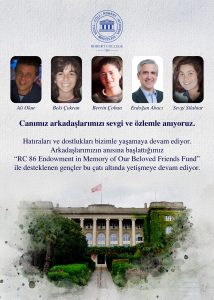
The Robert College community mourns the loss of our esteemed alumnus, Gökçe Bayındır, who passed away in July 2025.

Known affectionately among his friends as “Usta,” Gökçe was a man of exceptional character and remarkable mechanical aptitude. After completing his middle and high school education at Robert College, he graduated in 1965 and went on to build a distinguished professional career. He spent 29 years within the Koç Group, retiring in 2000 after serving as the President of the Tofaş Group. During the 1980s, he played a defining role in shaping the identity of the Tofaş “Kuş Serisi” (Şahin, Doğan, Kartal), leaving a lasting mark on Turkish automotive history.

Gökçe’s legacy extends far beyond his professional accomplishments. In an extraordinary act of lifelong loyalty and compassion, he devoted himself to the care of his Robert College classmate Zafer, who was paralyzed following a traffic accident at the age of 25, overseeing and organizing his care for 57 years.

A man of refined sensibilities, Gökçe also restored several historic mansions on Büyükada and, in a final gesture of public-minded generosity, donated his entire collection of antique works to state museums.

He is survived by his wife, Tiraje, and his children, Berna and Bars. He passed away in Büyükada, a place he deeply cherished.

“Usta,” may you rest in light.

With deepest condolences,
His Robert College classmates

Artist Pelin Toğrul RC 03 Presented a Solo Exhibition: Doğa, Doku, Dokunuş (Nature, Texture, Touch)

Pelin Toğrul ‘s solo exhibition Doğa, Doku, Dokunuş (Nature, Texture, Touch) took place between February 28 to March 22, 2026 at ArtisArt Gallery.

Built through the interplay of acrylic and decorative plaster, the works foreground texture as both medium and message. Surfaces are not simply seen but imagined as felt—drawing attention to the depth beneath what first appears flat. In this sense, the exhibition becomes a study of perception: how we engage with art not only through sight, but through memory, sensation, and instinct.

At the heart of the show lies a dialogue between nature and human intervention. Contrasts such as rough and smooth, rigid and soft echo the rhythms found in the natural world, while the artist’s hand introduces intention, control, and interpretation. Through this tension, Toğrul constructs a visual language that bridges organic processes with crafted form.

Material exploration plays a central role. Alongside acrylic and plaster, textile elements and occasional natural components are incorporated into the works, reflecting a layered and, at times, sustainable approach to production. These choices reinforce the exhibition’s emphasis on depth—both physical and conceptual—where each layer contributes to a cumulative sensory experience.

Ultimately, Doğa, Doku, Dokunuş positions texture as a conduit between the external world and internal perception. It reflects on how humans absorb inspiration from nature and transform it through touch, creating new forms of expression that are at once grounded and interpretive.

Bridging Voices Across Cultures: Canan Özgür RC 06 in Córdoba

Canan Özgür, an award-winning opera singer and Associate Professor at Ankara Music and Fine Arts University, will take part in an Erasmus+ teaching mobility in Spain, bringing Turkish vocal repertoire to an international academic setting.

Hosted by Conservatorio Superior de Música Rafael Orozco, the program will take place between April 21–23, 2026, in Córdoba, as part of the Erasmus+ collaboration between the conservatory and Ankara Music and Fine Arts University. Within this framework, Özgür will work with voice students in the Andalusia region, focusing on interpretation and performance.

At the heart of this exchange is a repertoire that carries cultural depth and musical nuance. Introducing works by prominent Turkish composers such as Muammer Sun and Turgay Erdener, Özgür’s teaching aims to create a dialogue between traditions—allowing Spanish students to engage with the tonal language, phrasing, and emotional landscape of Turkish vocal music.

By carrying songs across borders, Özgür contributes to a growing space where music becomes a common language—one that transcends geography while remaining deeply rooted in its origins. Through this residency, Turkish compositions will find new voices in Córdoba, shaped by a different cultural context yet connected through the universality of sound and interpretation.